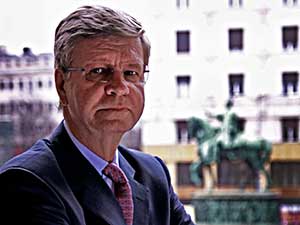
H. E. Mr. Christer Asp, Ambassador of Sweden to Serbia
Kingdom of Sweden
Finland, Austria and Sweden joined the European Union on 1 January 1995, in the fourth round of enlargement. These three countries were the first new countries to join the EU after the end of the Cold War. The then 15 members covered almost the whole of Western Europe. That decade became known as A Europe without frontiers.
This year these three countries are celebrating 20 years of membership in the European Union. Their experience, considering the course of negotiations for accession, and the obstacles they encountered upon and after becoming members of the EU,are valuable to candidate countries such as Serbia.
Quote: “Twenty years is not a long time in history but at least we can share our experience of 20 years within the EU, and also remember being outside the EU, and also remember the process of joining. I think these are important experiences that we can share with Serbia which is now on the way to the EU.It was not that long ago when we were exactly in your place.”
We were much honored to talk to His Excellency Mr. Christer Asp, Ambassador of Swedento Serbia.
1.Your Excellency, what was the course of your career in diplomacy before you came to Serbia? It would be nice to hear something about itsince you have a very rich career and it would beinteresting for our readers to hear about it.
I’ve beenposted to different parts of the world, starting in Indonesia.I’ve been posted to New York and Washington. I have spent 10 years in Brussels, during the time Sweden negotiated access to the EU andthen I stayed on after that to work for five years firstly with the SwedishCommission, and then the EuropeanCommission. I was Ambassador to Turkey for 5 years and then I came to Serbia. I could say that most of my career I have spent on the issue of the enlargement of EU. That’s why I was sent to Turkey. That is also the reason why I was sent here.We very strongly support the accession of Serbia to the EU.
2.What are your impressions of Serbia, in general? How do you feel about being in Belgrade? You’ve been here for 5 years, already.
The first and the most important impression of Serbia is that Serbia belongs tothe EU. I think that Serbia can contribute a lot to the EU, in the sense that Serbia is a key country, strategically a very important country in this part of Europe. I think there is a mutual benefit for the EU and Serbia, to see Serbia as a part of the EU family. I could also add that it is very easy for a diplomatto live hereand for a diplomat of my specialty in the EU, and for the enlargement of EU, it is an interesting place to be in, professionally, at this moment.
3.This year your country, along with Austria and Finland, will celebrate 20 years from entering the EU, and since you were a part of the negotiating team when Sweden joined the EU 20 years ago, can you tell us about the course of the negotiations, what were the problems you encountered, was there any opposition, and what were the compromises you had to make as a country?
It was not easy, it was very difficult. I know that each country likes to believe that their country is unique and that no one has had similar difficulties in joiningthe EU. This is not the case. It’s difficult for all countries because it is a huge adjustment process and it was also the case for Sweden. We had very difficult issues to overcome during our accession negotiations. For instance, we had environmental issues.Sweden had a higher standard than the rest of the EU. Normally, the case in negotiation is that you need to raise your standard, rules and regulationsto meet the requirements of the EU. But in this case, we had come much further than EU. We also had difficulties whenit came toregionalissues. Sweden is a very large and long country and in the north it is very scarcely populated and we need to support that part of Sweden in order for it not to be completely depopulated. And the EU rules on regional support did not fit our requirements. That was very difficult to overcome.
I could also mention an issue like oral tobaccowhich is a product in Sweden called (snuf). It is very traditional product in my country, and we have used it since the XVII century. Suddenly we were faced with the possibility that the product would be abolished or forbidden.That single issue could have tipped the whole balance.It is something traditional and people didn’t like the idea that those down there in the Brussels should forbid something that we’dused for almost 400/500 years.
So, in area after area, we had individual problems that could really have shut us out from membership of the EU. With persistence and a lot of hard work we eventually overcame these problems.
If you look at each acceding country, there have always been these kinds of difficulties, like you are facing now in Serbia. I think the important thing is to understand that you are not unique in all these difficulties.
4.In your opinion, at this moment, 20 years after joining the EU, what are the positive and negative sides of EU membership? Did EU membership fulfill the expectations of your citizens? And what are the areas where possibilities for improvement and change for the better exist?
The EU is a political project which is in constant motion. It’s being developed all the time and I think that in any political environment you can find positive things and you can find negative things. We have to look at the full picture and the big map and realize that we are living in a rapidly changing world, in a globalized world, where we’re all facing the kind of challengesthat need acommon approach, to work together to become stronger in order to meet those challenges. It benefits us to walk together with other countries in our part of the world in order to try to overcome and move our societiesin a positive way forward.
When we look back at the 20 years of membership, at the very outset,the Swedeswere, you could say, reluctant members of EU. We had a referendum after we finished the negotiations, and I think the referendum was at around 52-53%. It was very close that we didn’t join.But we did. But now, after 20 years, I think that it’s become gradually, more obvious to the people of Sweden that there arethese large benefits in working together with other countries in order to meet these kind of challenges I’ve mentioned.Now, we have quite a solid majority in favor of the EU.
I think joining EU was a good decision. I think it was a necessary decision because if we had been alone, we could have said that we are independent, we makeour owndecisions but in the kind of world we are living in today,this is a false argument. Because we are very much dependent on what is happening in the rest of the world. Our economy,the social benefits that we can offer to people aredependent on the fact that we can trade with other countries. We can do that from a better position within the EU. We were also very dependent on the EU market before we became a member. It is better to be on the inside and be part of the decision making machinery than to be outside and be completely dependent on the decisions that we cannot influence.
5.What makes the European project so appealing to your citizens, beside the fact that they consider themselves European, and what are the specific advantages provided to them by the EU?
As I said this has come gradually from being hesitant to gradually realizing that we can be an independent society working together with other countries. For instance, if you take the area of the environment where we had higher standards,beingpart of the decision making machinery within the EU, we can work with other countries in order to create a better environment. I could also point to the young people, the students in Sweden.They were more reluctant than others. Today a Swedish student can choose to study in any other country in Europe under the same conditions as students from that country. This was not possible before. Today, I would say that the majority of Swedish university students spend at least one year of their studies in another European country and they can, of course, get credit for that year when they graduate in Sweden. I think this also creates secondary, very important effects, because when young people can move easily across borders tospend time in other countries,that creates an understanding for other cultures and respect for how other people live,and that in turn brings stability and security to our countries.
6.At this moment Serbia is a candidate country, and negotiations started in January, 2014.In your opinion, how far along is Serbia on the path to the EU, and what will be crucial for Serbia to become a member state?
I think, we are exactly on track in the accession of Serbia. Of course, from the perspective of my own country, we could already have opened1 or 2 chapters with Serbia. But in a larger perspective, we are exactly on track. We finished the comparison between our regulatory frameworks, what we call the screening process, exactly on time and I am fully convinced that we will start to open negotiating chapters this year. So things are proceeding well. This is not an easy process and it takes time. You cannot cut corners. It has to be done step-by-step.First, we have to identify which laws have to change,then there has to be the parliamentary decisions to change those laws and then comes the third step – the implementation of those laws and regulations.
What is important in this process is that we are, from the side of the EU, able to explain values that we share within EU member states, because the value is really cement, the glue that keeps this cooperation together. And for an acceding country it is very important to accept and to join in these kinds of values,whether we are talking about human rights issues, foreign policy issues, or economic issues.And this cannot be done overnight; it takes time and patience. And patience is not always something that everybody has.
We were sometimes very impatient with the EU during the time of negotiations, because we thought they should have had more understanding for our position.Gradually we understood that we have to adjust to the EU: It was not the EU that was going to join Sweden, it was Sweden that was going to join EU.
7.How do you see Serbia’s EU integration in the future, and do you think that upon joining the EU Serbia will become more appealing to investors, not just from Sweden but from other countries as well?
The business community usually moves faster in this respect than the political community so they already anticipate that when accession starts, that this country will be a part of the huge internal market, where goods and capital and services can movefreely.
We already have a lot of Swedish companies here. Since we had a very close relations with the former Yugoslavia, many of the large Swedish companies have remained here and also in the region.What we have seen lately,and is very interesting, is that we have some increase in interest from IT and communication companies. This is a sector that has grown tremendously in my country in past 15 years. During the last 2 years we have seen around 7 Swedish IT companies that have established themselves here on the Serbian market. I expect that trend to continue and I think this is a very positive development because these are companies of the future.
8.What is the current diplomatic and economic cooperation of our countries like, what was it like in the past, and what should be changed in Serbia in order to improve that cooperation?
We have always had very good bilateral relations with the former Yugoslavia and afterwards with all the individual countries from the region. Relations have traditionally been very good. Today, I would even say excellent. But it doesn’t mean we should sit down and be very pleased with what we have achieved. Excellentrelations can always be improved. This is what the Embassy is doing here and what the Serbian embassy is doing in Stockholm. I keep very close contacts with my Serbian colleagues in Stockholm, in order to see how we can strengthen relations in different areas.
9.What is the nature of the foreign trade cooperation between our countries and which are the industries with the most potential in Serbia? What does Serbia export to Sweden, and what does it import from Sweden? When it comes to investments, how do investors from Sweden regard the Serbian market? What are the most influential Swedish companies that have made investments here?
Trade should expand much more, as I see it. This is also the topic of which I have constant dialog with my Serbian colleagues and the Serbian Ambassador in Stockholm.It’s significant but it should be much more.So that’s an area that we would focus on in the years to come. I expect that the IT sector will grow considerably here, attracting more Swedish investment. And it’s attractive in the sense that you don’t need large production facilities. You need people with ideas, brains. This is also one of the reasons why Swedish companies in this sector come here, becauseyou have a good educational system when it comes to this sector. Large Swedish companies like Volvo, Scania and Ericsson have expanded their activities here and also use Serbia as a regional hub for their activities.
Of course, we have theissue of Ikea. We expect, if everything goes according to plans, that the first of 4 or 5 Ikea stores should be up and running towards the end of 2016. I think that this itself sends an important signal because if a large global company like Ikea wants to establish themselves here in Serbia, it also means that they believe in the future of Serbia when it comes to economic development.
10.When it comes to investments, how do investors from Sweden regard the Serbian market? What are the most influential Swedish companies that have made investments here?
I should mention TetraPak, a huge global Swedish company. It was established 50 years ago in Gornji Milanovac. This company has been expanding very quickly in last few years so now they are one of the largest exporters in Serbia. It’s a Swedish company exporting to large number of countries around the world, including back to Sweden. This company has one of the most efficient production facilities. Globally, it is company they havehere in Serbia which sets the standard for production around the world. I think that is a very good example ofthe potential for companies here.
About 80 companies from Sweden are currently active in Serbia. Some of them are Volvo Trucks, Scania, Oriflame, Absolut Vodka, ABB, Lindex, Securitas, Ericsson, MEDICON, Atlas Copco, Volvo Cars, Scania Credit, SKF, Duni and H&M etc.
11.Can you tell us about the relationship between Serbia and Sweden in the fields of science, culture and education?
In my view, a strengthened bilateral relationshipshould also cover culture.This is an area where we have really intensified our activities. For instance, two years ago we put a Cultural attaché here. We don’t have many Cultural Attachésin Swedish Embassies around the world, but we put one here in order to encourage more activities in the area of culture.And that has proved very fruitful. We have around 50 different cultural projects every year. With the projects we have, we try to base them on the kind of values that we find important in my country. As an example I could mention that we have set up a play called Sevenfocused on violence against women, which is an important topic because it brings to bear fundamental rights and violation in all countries around the world. We try to link the cultural activities that we have with these kinds of value based projects.
TheCreative mentorship program brings to bear the role of women in society and the importance that women form as part of the development of society because what we have learned in my country is that if you can increase activities in society where women can and should participate, you will also increase the economic development of that country and the economic growth. These are the kind of projects that we try to put emphasis on.
Seven is a play based on personal interviews with seven women from Russia, Pakistan, Nigeria, Northern Ireland, Afghanistan, Guatemala and Cambodia, who have overcome impossible odds in their work for human rights.Seven is described as a play about “seven women, seven stories and a thousand questions”.
In the area of education, we will for instance participate in an Educational Fair this autumn, because we want to see more students from Serbia coming to my country.We have a very good educational system.You don’t have to learn Swedish necessarily to start a Masters degree or a PhD because many of the courses are in English. Cost wise, it is often cheaper to study in Sweden than in any other EU country. And, of course, we have a limited number of scholarships through the Swedish Institute for Masters and PhD students.
12.How would you present your country as a tourist attraction? What aspects and landmarks would you highlight?
We can’t offer,for instance,palm trees, or a tropical climate. But what we do offer in Sweden is nature, very clean nature and clean air. We also have a veryold cultural heritage. When it comes to nature and a clean environment, this is something that we are also working on,now and here in Serbia. Sweden is the third largest bilateral donor; we also give through EU funds, but bilaterally we have set aside around 30 mil euros. Part of that bilateral assistance goes to different kinds of environmental projects. This is going to be important in your accession negotiations but I think it’s also important for any developing country that you don’t forget about your own nature. You have beautiful nature here and you should take care of it. What you leave behind is for future generations.
13.What are the things you particularly like or don’t like in Serbia? And do you plan to continue living here after your term ends?
What I don’t like in Serbia is that you are not already a member of EU, because I really think that you should, and must become a member. For foreigner like me, it is very easy to live here, professionally and socially. What I particularly like is that you feel very welcome and safe in this country. Perhaps it’s because we have had such close relationship. We have very large Serbian Diaspora in Sweden.We might be different parts of Europe but Serbia and this part of Europe have always felt closer than the geographical distance.
The change insociety which I have seen over the past five years is something very positive. Maybe it is difficult for you who are born here or live here to see these changes, but coming as I do and being trained to look at these kinds of developments, I see very positive changes here.The kinds of reforms that the government is now undertaking, basically for Serbia itself, but also in view of the reforms we need to do to join EU, is going to change this country in a very positive way in the future.
14.How do you spend your free time and what is your favorite memory from Serbia?
Some of my oldest friends come here once a year and we go up to Kopaonik to ski. That is a beautiful place to go. I think that part of Serbia is very attractive. In my spare time I like to take a walk along the river and then to have a coffee on one of the boat restaurants. When I’m not traveling, this is usually what I do and I really like to go to the restaurants. I will always come back to this region because my son lives in Zagreb.