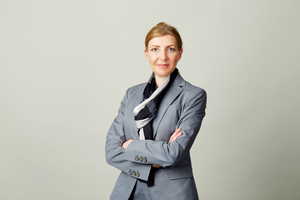
Csilla Ihasz, President of Management Board of UniCredit Bank Serbia JSC
15 years of loyal service to our customers
UniCredit Bank Serbia JSC is a member of UniCredit Group, one of the leading financial groups in Europe and the largest international banking network in Central and Eastern Europe (CEE), which conducts business in 16 countries, and successfully serves millions of clients with more than 141,000 employees and approximately 7,800 branches. UniCredit Bank Serbia marks 2015 as one of the most successful business years since it started its operations in Serbia. Third position on the market was confirmed when it comes to total assets, and a double digit market share, above 10%, was marked for the first time.
At the same time, the bank’s leading position in terms of efficiency and productivity was additionally empowered, which brought growth to the market share when all other relevant aspects are concerned. In 2015, UniCredit Bank’s net profit reached RSD 6.37 billion, marking a growth of 16% in comparison to the previous year. At the same time, the bank continued to prove its commitment to the Serbian market, which is manifested in balance sheet growth by 16% compared to 2014, to the amount of over RSD 308 billion. Client focus, a new service model and innovative products contributed to the client base increase by nearly 15%, equating to a number of around 285,000 clients, which influenced deposit growth by 24% to an amount of over RSD 175 billion.
Through corporate and retail lending in 2015, following the tradition of previous years, UniCredit Bank Serbia continued to prove its commitment to the local market and readiness to support the development of the local economy and fulfillment of its clients’ needs. The total volume of approved loans reached an amount of RSD 202 billion, marking a growth of 9% compared to 2014. Total operating income at the end of 2015 exceeded RSD 17 billion, which is 19% more compared to the previous year. However, it is even more important to stress that the number of employees continued to rise. At the end of 2015, it reached 1,145, which is 5% more than at the end of 2014.
Ms. Csilla Ihasz, President of Management Board of UniCredit Bank Serbia JSCspeaks for Profit magazine.
1.Ms Ihasz, could you tell us more about yourself – where were you born, where did you receive your education and what influenced the path of your career?
I grew up in Zalaszentgrót, a small town in Western Hungary. There I finished primary and secondary school. Because I was talented in languages, my parents suggested that I study at the Institute for Foreign Affairs and Trade in Budapest. I was in my second year of studies when I decided to join a friend and travel to the USA to work in a summer camp and perfect my knowledge of the English language. Three months turned into three and a half years. I decided to complete my Bachelor studies there, after which I completed my MBA studies at the Brunel University in London.
My career was most strongly influenced by the years I spent in the USA, primarily by living with a family with a very strong work ethic and a clear desire for success. This influenced both my professional and my personal development. All of this, together with the openness to new experiences and an endless curiosity I got from my parents, influenced the formation of some of my core values.
2.Your professional experience is very wide. Please, tell our readers more about your professional experience and career before you came to Serbia?
My banking experience, over 20 years long, includes Citibank, ING Bank, General Electric and UniCredit Bank in Hungary, Austria, Czech Republic, and Sweden, both in corporate and in retail sectors. The roles and responsibilities grew from a corporate relationship manager, retail product and business development leader to head of retail business. Before joining UniCredit Bank in Serbia, I supervised retail business in 11 countries in Central and Eastern Europe (CEE).
3.You came to Serbia three months ago, as President of Management Board of UniCredit Bank. What were your expectations and were they much different from what you encountered at the bank?
As soon as I found out about the appointment, I started with my preparations. I collected useful information from my predecessor, talked to colleagues who held different positions in Central and Eastern Europe, as well as with Head of CEE Division. I came to Serbia well prepared and I already had a brief insight into our bank’s business, so I was not surprised when I came to a strong bank, with a fine reputation and good business. I also met a strong leadership team, which was very devoted to the business and which consisted of people who are very successful in their own areas of specialization. That said, the bigger challenge will be to find new ways to increase value for our clients and interest groups. I already have an insight into some of the possible strategic directions which could bring about beneficial changes and raise our bank to a higher level.
4.Although you have not been in Serbia for a long time, you have had the chance to get to know the local market, the banks which conduct their business in the country, and the laws. In your opinion, what are the main differences between the Serbian banking market and the markets of neighboring countries?
I believe that the country has already been well integrated into the Central-Eastern European environment, and therefore its market shows more similarities than differences. It is also not unique in market overabundance, when it comes to the number of banks present here. Competition is mainly reflected in pricing policies. This is true for both corporate clients and private individuals. Growing client need will force banks to stand out somehow, primarily in terms of the value they provide and the clients’ experiences. I expect that clients will not only consider the transaction price when making a decision, but also the rapport with the bank, the personal experience, as well as all the other additional business opportunities the bank can offer. This transfer will be possible primarily as a result of the digital transformation in which most banks heavily invest. As it is the case in technologically more developed countries in the region, such as Turkey, the critical issue will be how to put this development into a strategic context, i.e. how to point out the real problems, the burning business issues for which technology can offer a solution.
5.Where do you see growth potential in the Serbian market when it comes to your bank, as well as when it comes to business in the country in general?
What is of key importance for stable and enduring economic growth is strong internal demand, which is conditioned by a higher employment rate which leads to higher disposable incomes. One of the ways to achieve this goal is to attract direct foreign investments. The government has already taken numerous measures when it comes to increasing competition, but support in the continuation of structural reform implementation is essential. I cannot help mentioning the efforts for the modernization and expansion of infrastructure sustainability, as well as the continuation of the development process and the implementation by export companies. The industries with great developmental potential are the automotive sector and its related industries, software development, as well as the food industry and agribusiness. Undiscovered potential also lies in the SME sector, which is the initiator for growth in developed companies. These companies not only contribute greatly to the GDP and employment increase, but they also have an important role in encouraging innovation and new technology development.
6.In 2015, UniCredit Group announced the Digital agenda as a crucial part of its strategy. Could you tell us what initiatives were implemented locally in order to achieve digitalization?
We are all aware that the use of digital channels is becoming more dominant, when compared to traditional banking. UniCredit Group’s recent studies have shown that in the following three years the number of internet banking users could double, while the number of mobile banking users will be seven times larger. UniCredit Bank has accordingly created a Digital agenda, one of the main pillarsof the Strategic plan, which includes EUR 1.2 billion investment into the European network.
UniCredit Bank in Serbia is working on the development of different services to meet both the needs of the local market and clients’ needs. Until now, we have had a chance to introduce our new website which is entirely sales-oriented and created according to the most contemporary standards. It has been completely adapted to the needs of our clients and the digital era in which we live. We have also improved the e-banking platform, and our digitalization work does not end there. By the end of the year, we plan on introducing numerous innovations in the field of digital banking.
7.For a few years now, NPLs have been a major problem in the local market. What is the situation in your bank when it comes to the level of non-performing loans?
Although the level of NPLs in Serbia is one of the main problems which the banking sector faces, because of the high level of capitalization, most of the banks in Serbia are willing and capable of coping with it. But, it should be clear that this is a joint process in which different interest groups - government regulators and business banks - should participate. Another important matter is the introduction of a set of stimulating measures which influence regulatory framework improvement, the increase in the efficiency of the justice system, the increased level of creditor’s protection, and the creation of mechanisms for out-of-court debt restructuring. I would like to note that all of this has already been specified by the local NPL Resolution Strategy and we at UniCredit are very glad to see the positive steps in its implementation, where the efforts of the National Bank of Serbia can clearly be recognized. When it comes to UniCredit Bank Serbia, the level of NPLs is under control and is significantly below the market average, owing to tight risk management and a broad internal set of measures.
8.Given the turbulences which have been striking markets around the world, it is essential to maintain a bank’s portfolio and to improve its quality. How are you dealing with this issue in Serbia?
The whole market is facing many geo-political and economic inconsistencies which pose a great challenge not only for banking, but for all industries. However, UniCredit Bank, which celebrates 15 years of business in Serbia, is capable of achieving very good results. Some of the key strengths of our business model which have ensured our success thus far are that the client, the efficiency and development of people, and tight risk management are always being focused upon as well as good results being coordinated with a satisfactory quality of our growing loan portfolio.
9.The banking market in Serbia is considered highly competitive. From your perspective, in what manner should the banks adapt in order to fulfill its clients’ needs?
The level of the competition in the Serbian banking market is very high. Focusing on clients is imperative in today’s business andis a complete part of all our activities. I am very pleased that our bank is a leader on the local market in terms of client satisfaction. In the retail division, the TRIM customer satisfaction index has increased by 3 points compared to 2015; when it comes to corporate clients, we have exceeded the results of the market. The results of these analyses show that individuals’ habits change each year. Their knowledge of the financial sector keeps growing, which compels banks to be more transparent, to focus on the quality of advice rather than just on favorable offers, to adapt their services to different client needs and to provide a suitable offer for each client in greater detail. On the other hand, corporate clients are traditionally better informed and more demanding and they insist on a higher efficiency of provided services. Expectations keep rising. So, my answer to the question about how I see the adaptation of banks is that the adaptation process already started a while ago. It is about the ability of banks to offer a product which conforms to clients’ needs, to try to make clients’ life easier by providing them a simpler and faster service. That is what makes the difference between competitors.
10.In your professional opinion, how will the banking market change in the next 5 years?
I believe that the banking market will look completely different in 5 years. I expect that the changes we see today will continue to accelerate in a significant manner. Encouraged by technology, new competitors will continue to take a share of the traditional banking value chain. Regulators will attend to client protection more and impose stricter rules on all competitors. Of course, we must not forget the clients, whose constantly developing demands will continue to encourage innovation and the search for the best ways to satisfy their needs, and this will practically become a must for most organizations. The way in which this will reflect on human capital development, the allocation of the resources for new ideas, relevant process establishment and finally the coordination of the institution is a part of a well-made execution plan which will make the difference between winners and those less successful.
On the local market, your bank has been recognized as an employer who offers its employees the possibility of development, the possibility of an international career, and cross-functional change. Could you tell us something more about your employee development strategy?
The essence of our strategy is to employ people for a career, not just for a position. To achieve that, we have focused on professional growth and development of our employees. At the same time, we enable them to build cross-functional
careers, but we also encourage them to be responsible and in charge of their careers. Our work is crowned not only by business excellence and client satisfaction that we have achieved in the previous period, but also by the fact that we have an organization which is employee-centric, always focusing on the opinions of our people. Finally, I would like to point out that our bank records growth in the number of employees each year. Namely, if we compare the 2008 numbers with today’s numbers, we would perceive growth by 33%, while only in the last 18 months the growth has been 10%.
11.The bank also recognizes the importance of solving society’s social problems. Could you tell us more about the Corporate Social Responsibility Strategy and the level of its implementation?
We have adopted a responsible business approach when it comes to all of our activities, regardless of whether they are typical banking operations, civil initiatives or philanthropic activities aiming at supporting social inclusion. When I say “we”, I literally mean all the employees in UniCredit Bank. Besides activities which mostly demand financial support, we believe that the true, long-term value that we can give to society is to share our knowledge and expertise with it. That is why we, amongst ourselves, call this year The Year of Volunteering. Our engagement in mentorship and consulting more than doubled.
Besides these activities, since 2008, we have conducted several socially responsible activities in cooperation with the UniCredit Foundation, which has enabled us to invest over EUR 1.8 million in different projects in Serbia. The projects are different – starting from “Project Migration”, whose aim was to draw attention to migration, and the “Gift Matching Program” which involves employee participation in humanitarian activities and promotes a volunteer culture, all the way to the “Micro Marketing Budget”, through which the bank supports initiatives which are of great importance to local communities. Last but not least, we are extremely proud of the “Idea for a Better Tomorrow” competition, which is devoted to social entrepreneurship development in Serbia. Through this project, we aim to identify the products and services typical for this country, which can simultaneously contribute to both the improvement of the Serbian image in foreign countries, and to its export potential.
12.We are all aware that working in the banking sector can be very stressful. How do you reduce everyday stress?
I can confirm that complicated situations occur every day. Difficult negotiations, problematic decisions, occasional dilemmas. However, I do not see them as stressful situations. I do not see them as obstacles that I need to overcome. I rather use them to observe my leadership style and find new areas for improvement. Professionally, as well as personally. Rilke’s words come to mind: “That if something is difficult, there must be a reason for more of us to do it.”
13.How do you spend your free time in Belgrade?
My exploration of Belgrade consists of three parts. First of all, I am still in search of an apartment. As a part of this process, I am visiting different parts of the city and trying to find the one that best suits my lifestyle. I have to say that I am more of a city person, so I will probably live in the immediate proximity of the city center. Second of all, running is another way for me to explore Belgrade, and so far, it has included the Sava and Danube river banks, Ada and Kalemegdan. They all have a unique feel about them, but the confluence of the two rivers is my favorite running route. Finally, I am very lucky to have an office in the city center. That way, I have a chance to take a walk during my lunch break, to enjoy the liveliness of Knez Mihailova Street and occasionally treat myself to a vegan ice cream near my office.
14.What is your life motto?
"It is only by running that you learn the value of standing still."